
There are a variety of vision plans that work very well for individuals and families who don’t have access to employer sponsored vision plans. The frame allowance seems to be drive the monthly premiums. The extra lens options are what make eyeglasses expensive.
This review of vision plans is heavy on VSP. There are several marketing channels that offer VSP vision plans. All the plans are similar with the monthly premium driven by the frame allowance. Also included are the Blue Shield vision plans to illustrate how most individual and family vision insurance is similar.
VSP Vision Plans

VSP offers monthly premium discounts for multiple family members. The best deal is if you have a family of more than 3 household members. Blue Shield offers no family discounts. Remember, all individual and family plans include pediatric dental and vision for children 18 years old and younger. There may be no reason to include your children in the vision plan if it is already embedded in the health plan.

You can enroll in a VSP vision plan direct with VSP or through the Morgan White Group, a group association. There are two VSP plans that are branded or align with Covered California guidelines, the VSP-120 and VSP-175. You don’t need to be a Covered California member to enroll these plans.
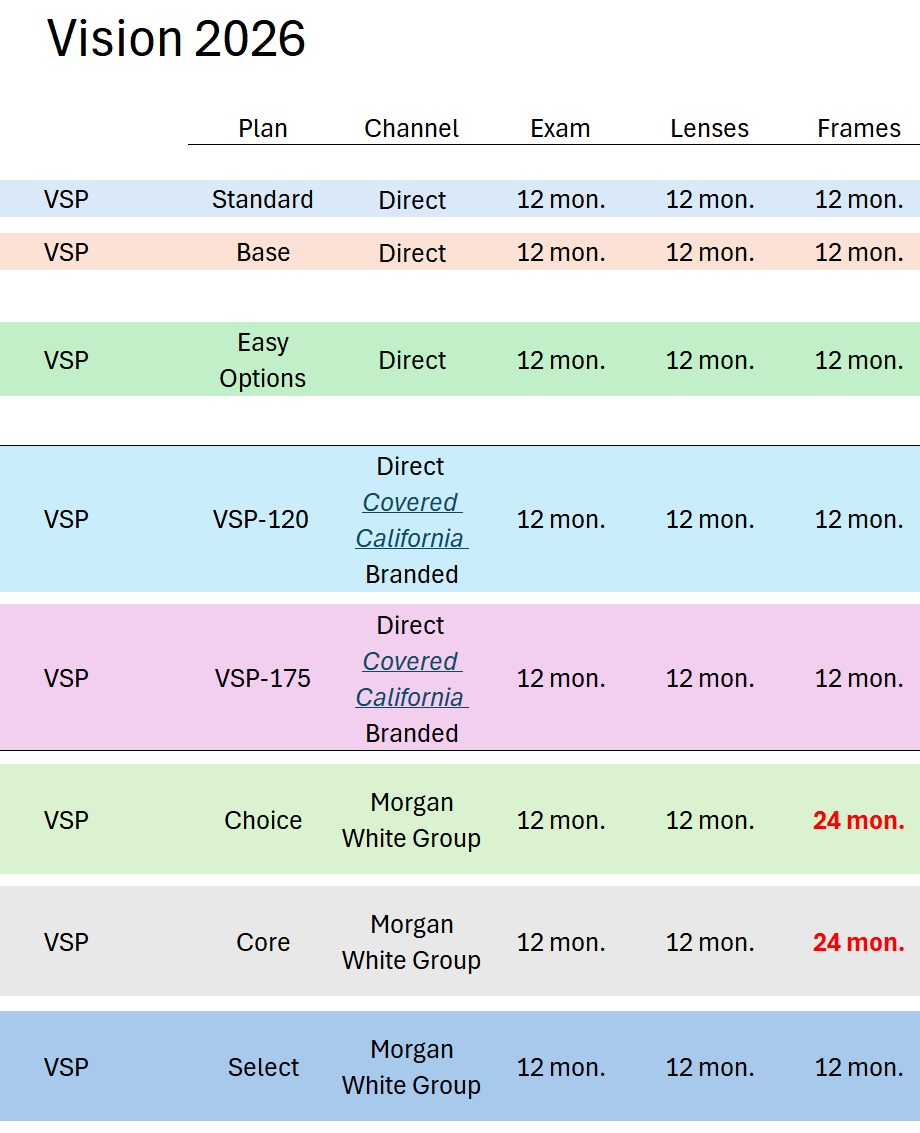
All of the VSP plans will have 12-month frequency for exams and lenses. You can also get a frame allowance every 12-months except for VSP Choice and Core plans through Morgan White Group, which is every 24-months.
All copayments, allowances, and lens option costs are when you use VSP contacted optometrist. The plans do have out-of-network optometrist coverage, but your costs will be higher.

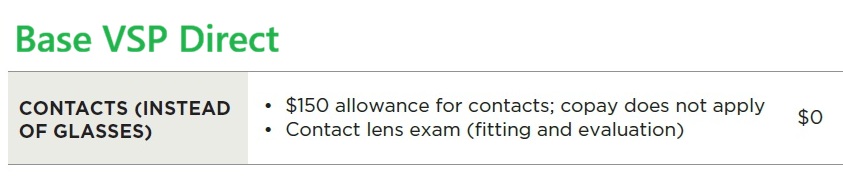
The exam copayment for most plans will be $15. The material copayment will be $25 regardless of the plan or marketing channel. What is different is the frame allowance which can also be applied to contact lenses. The most generous frame allowance is the Morgan White Group VSP Core and Select plans at $200. Under the Easy Option VSP direct plan, you could get a $230 frame allowance.

VSP EasyOptions plan has a higher premium because of the additional frame allowance of coverage for other lens options.
Lens Option Costs

The extra lens options are what can make eyeglasses expensive. For example, progressive no-line multifocal lenses can cost up to $175. I usually load up my lenses with scratch resistance ($33), anti-glare ($85), impact resistance ($35), progressive ($175), and UV protection ($16) for minimum of $344 before the cost of the frames. These are the maximum amounts and your cost for the various options may be less.
The Covered California branded VSP-175 includes several lens options at no cost. There were no details for the Morgan White Group VSP plans on the lens options cost. I assume they will be similar to the other VSP plans.
Blue Shield of California Vision Plans

Many of the health plans offer vision plans similar to VSP. Blue Shield offers the Ultimate Vision 15/25/120 and 15/25/150 plans. The $120 frame allowance plan is very reasonable at $7.90. The higher frame allowance plan of $150 is $14.70 monthly premium. Blue Shield does not offer family discounts.
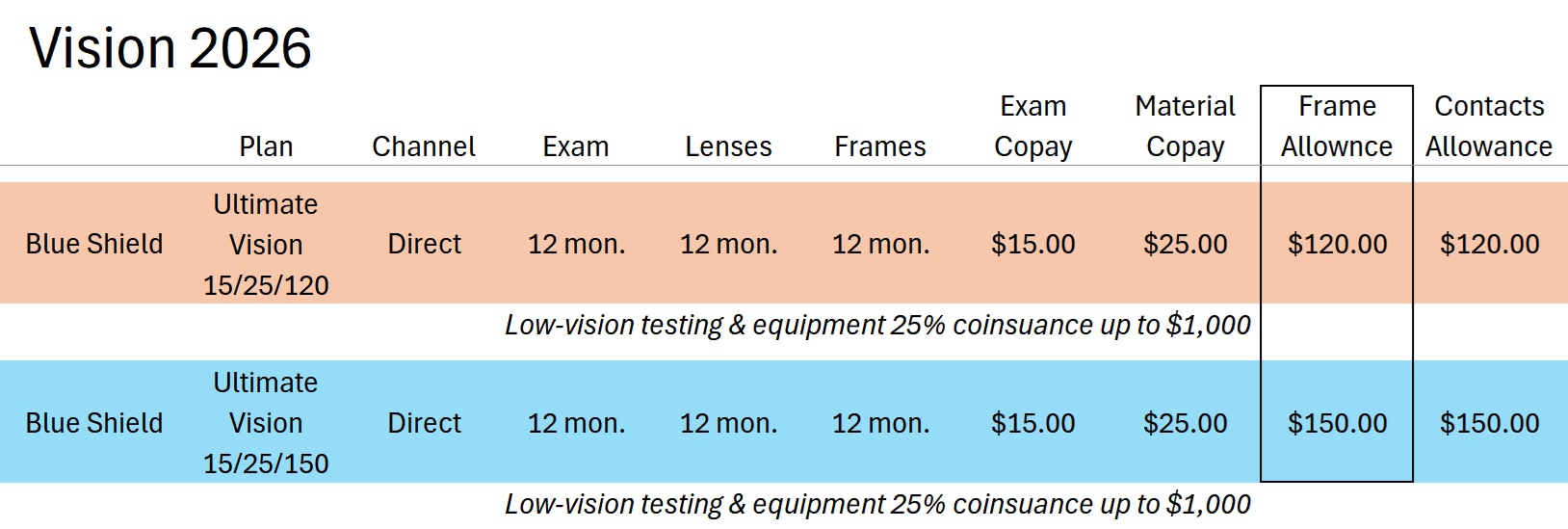
Frequency and copays of the Blue Shield vision plans are the same at VSP. Blue Shield does note that there is coinsurance of 25 percent for low-vision testing. I’m not sure if VSP offers this discount. Blue Shield contracted ophthalmologists can also be considered as in-network providers for their vision plan.
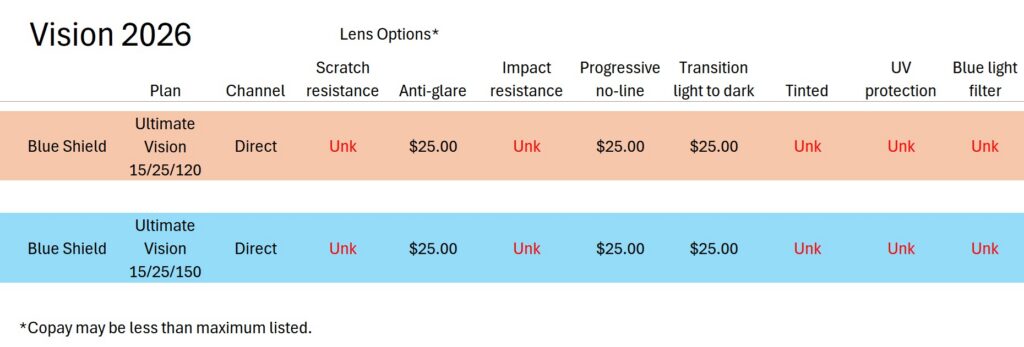
The lens option costs are similar to VSP. However, there was no maximum amount for scratch resistance, impact resistance, tint, UV protection, or blue light filter. Otherwise, the Blue Shield plans are in-line with VSP, albeit with a smaller network of providers. Blue Shield states you can use their vision plans at Lens Crafter, Walmart, and Costco.
To get a quote for VSP vision plans, you can visit InsureMeKevin Vision Plans webpage.
YouTube video of vision plan review.

