A guide to off-exchange PPO and HMO options, benefits, rates, and provider networks
Blue Shield of California will offer a variety of PPO and HMO individual and family plans in 2027. Californians can enroll through Covered California or purchase certain plans directly from Blue Shield outside the exchange.

Most standard benefit design plans—Bronze 60, Silver 70, Gold 80, and Platinum 90—have essentially the same benefits and generally the same rates through Covered California or off the exchange. One important exception is the Silver 70 plan. If you are certain you will not qualify for a Covered California subsidy, an off-exchange Silver 70 plan may reduce your premium by roughly 5%.
This guide focuses on several Blue Shield plans available only off exchange, along with sample 2027 rates and important provider-network considerations.
Blue Shield’s 2027 Plan Options
Blue Shield will offer both PPO and HMO plans. PPO plans are available through out the state and may include out-of-network benefits, although staying in network usually produces the lowest costs. HMO availability varies by location and is concentrated in metropolitan areas and larger suburbs.
New for 2027, Blue Shield will offer a Bronze 60 HMO plan. The carrier will also continue to offer certain off-exchange-only PPO and HMO plans. By contrast, the income-based Silver 73, Silver 87, and Silver 94 plans are available only through Covered California.
Bronze 7250 PPO: Off Exchange Only
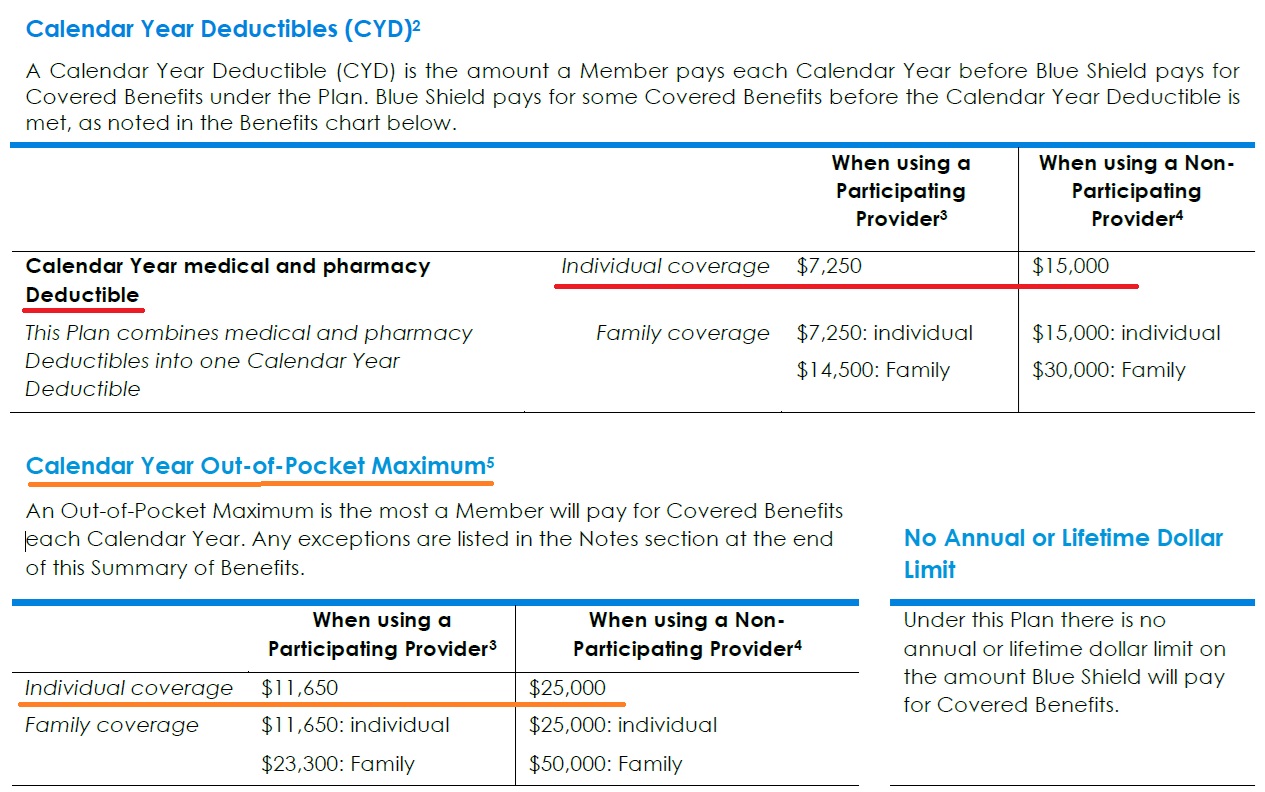
The Bronze 7250 PPO combines medical and pharmacy expenses under a $7,250 individual deductible. The individual maximum out-of-pocket limit is $11,650. After your deductible, many covered services are subject to 50% coinsurance until you reach that limit.
Key benefits
- Three provider visits per calendar year at fixed copayments. These may be any combination of primary care, specialist, or urgent care visits.
- After the first three visits, those services are subject to the deductible and after the deductible is met, generally 50% coinsurance.
- Teladoc consultations and certain family-planning services have a $0 copayment and are not subject to the deductible.
- Emergency room and inpatient hospital services require you to satisfy the deductible before the plan begins paying its share.
- Tier 1 prescriptions are $10 for a 30-day supply and are not subject to the deductible. Other drug tiers are subject to the deductible, followed generally by 50% coinsurance.
Pediatric dental and vision benefits are included. Preventive dental services are generally $0, basic dental services generally require 20% cost sharing, and major services generally require 50%. Vision benefits include an eye examination and a $150 allowance for eyeglass frames. The Children’s dental and vision benefits are embedded all of the plans, on or off exchange.
Bronze 7500 HMO: Off Exchange
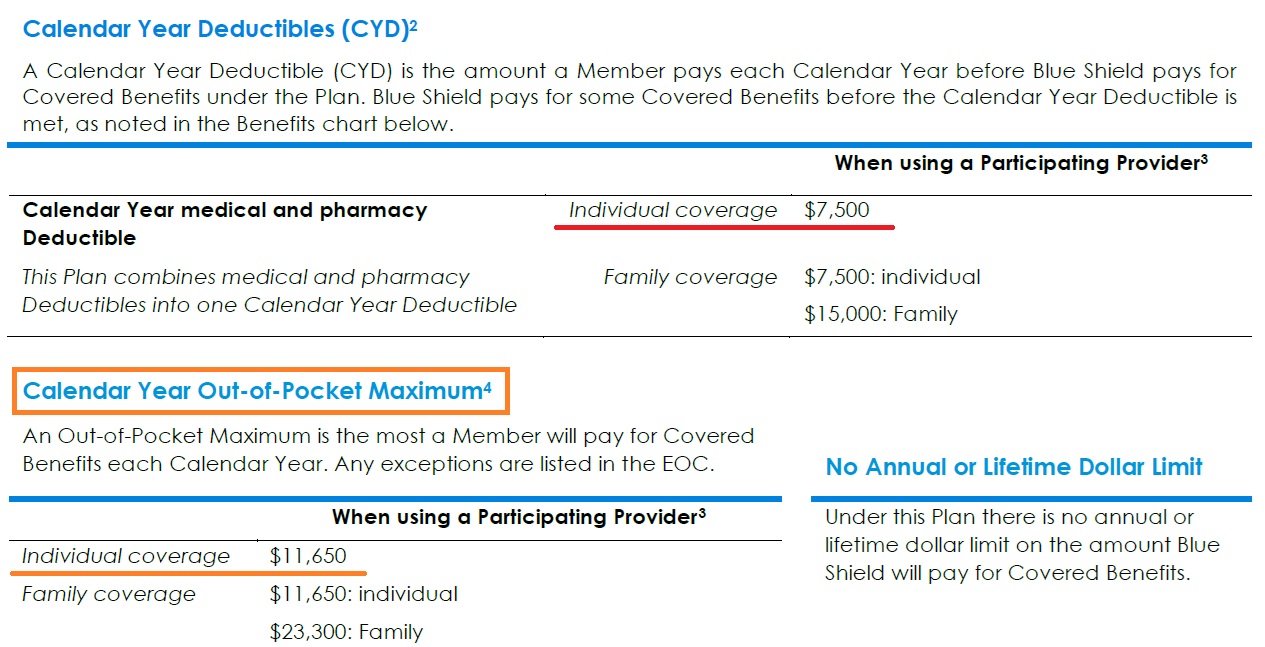
The Bronze 7500 HMO has a combined $7,500 medical and pharmacy deductible and an $11,650 individual maximum out-of-pocket limit. As an HMO, it does not provide routine out-of-network coverage.
This plan offers fixed copayments for several services before the deductible:
- Primary care visits: $65
- Specialist visits: $95
- Nurse practitioner visits: $65
- Acupuncture: $65
- Chiropractic care: $20 per visit
- Urgent care: $65
- Laboratory services: $65
- Basic outpatient radiology: $115 per visit
Emergency room and many hospital services are subject to the deductible and then 50% coinsurance. Tier 1 prescriptions cost $15 without satisfying the deductible. Tiers 2 through 4 are subject to the deductible; afterward, Tier 2 prescriptions cost $115, while Tiers 3 and 4 generally require 50% coinsurance.
Silver 1850 PPO: Lower Premium, Different Cost Sharing
The off-exchange Silver 1850 PPO may save money compared with the Silver 70 plan, but compare the benefit details carefully. Some services that have fixed copayments under Silver 70 may be subject to the deductible under Silver 1850.
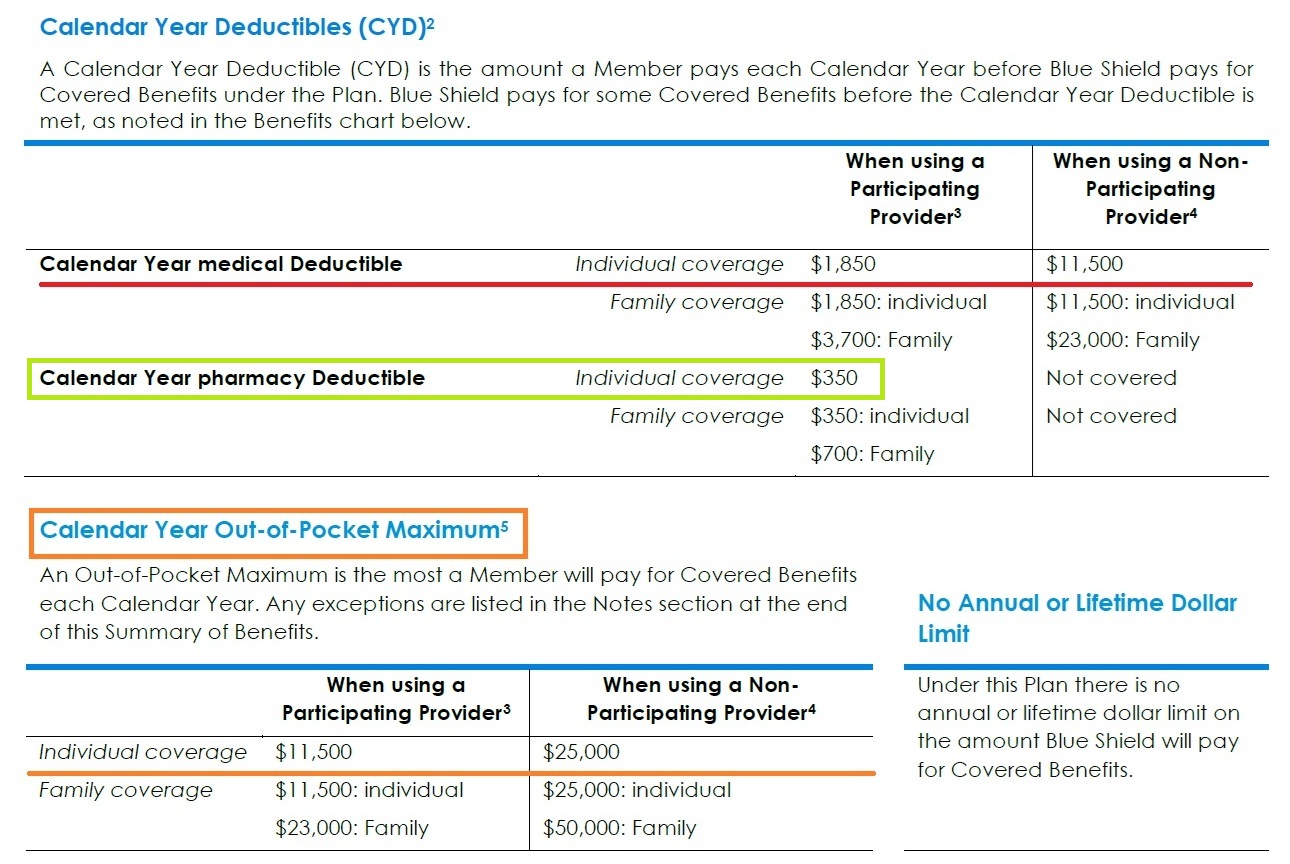
- Medical deductible: $1,850
- Pharmacy deductible: $350
- Individual maximum out of pocket: $11,500
- Primary care visit: $55
- Specialist visit: $85
- Acupuncture: $55
- Chiropractic care: $15 per visit
Emergency room services are subject to the medical deductible, then 40% coinsurance plus a $300 visit charge. An ambulatory surgery center generally costs 25% coinsurance after the deductible, while a hospital outpatient facility may add a $250 visit charge and increase coinsurance to 40%. Inpatient hospital care is generally 40% coinsurance after the deductible.
Laboratory tests are $50 at an in-network facility. Basic X-rays and some imaging services are subject to the deductible and then 35% coinsurance, which is an important difference from plans that use fixed imaging copayments.
Tier 1 prescriptions are $20 and are not subject to the pharmacy deductible. After satisfying the $350 pharmacy deductible, Tier 2 prescriptions cost $75, Tier 3 prescriptions cost $150, and Tier 4 prescriptions require up to 35% coinsurance, capped at $250 for a 30-day supply.
Silver 2800 PPO HDHP: HSA-Compatible Coverage
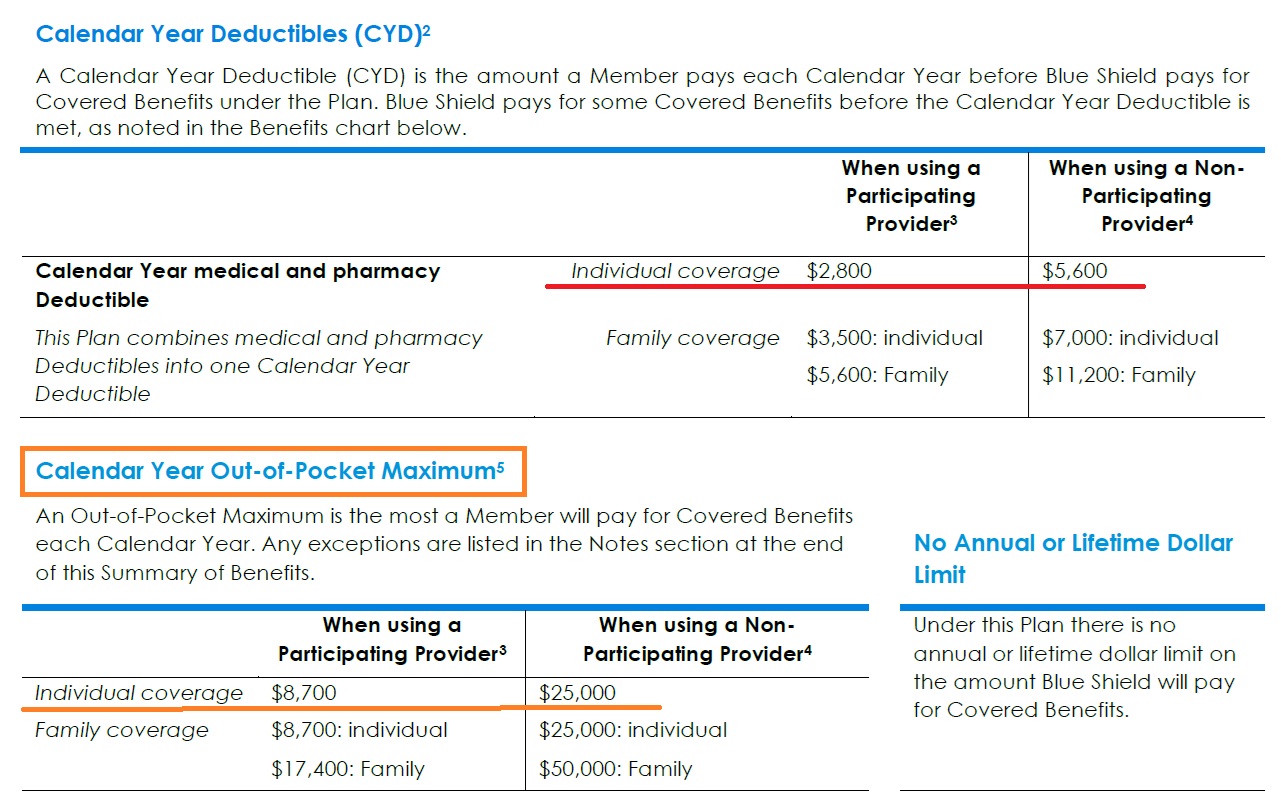
The Silver 2800 PPO high-deductible health plan is eligible for health savings account contributions. It has a combined $2,800 medical and pharmacy deductible. The maximum out-of-pocket amount is $8,700 that is lower than most Bronze and Silver plans.
Most physician and outpatient services are covered at 35% coinsurance after the deductible. Emergency room services are generally 40% coinsurance plus a $150 visit charge. Outpatient hospital surgery is generally 35% coinsurance plus a $250 visit charge, while inpatient hospital care is generally 40% coinsurance.
Tier 1 prescriptions cost $20 after the combined deductible. Tiers 2 through 4 use coinsurance, with a maximum cost of $250 for a 30-day refill.
Sample 2027 Monthly Rates
The following examples are for a 40-year-old individual without a subsidy. Premiums vary by age and location. California has 19 different rating regions.
Los Angeles County
| Plan | Monthly premium |
| Bronze 60 PPO | $714.58 |
| Bronze HDHP PPO | $709.20 |
| Bronze 7250 PPO, off exchange | $693.77 |
| Bronze 7500 HMO, off exchange | $508.41 |
| Silver 70 PPO, off exchange | $850.77 |
| Silver 1850 PPO, off exchange | $807.65 |
| Silver 2800 PPO HDHP, off exchange | $783.37 |
Santa Clara County
| Plan | Monthly premium |
| Bronze 60 PPO | $995.56 |
| Bronze HDHP PPO | $988.07 |
| Bronze 7250 PPO, off exchange | $966.57 |
| Bronze 7500 HMO, off exchange | $860.71 |
| Silver 70 PPO, off exchange | $1,185.31 |
| Silver 1850 PPO, off exchange | $1,125.23 |
| Silver 2800 PPO HDHP, off exchange | $1,091.40 |
Check the Provider Network Before Enrolling
Blue Shield has published county-level information showing medical groups and hospitals associated with its PPO and HMO networks. This can make it easier to determine whether your physicians and preferred hospitals participate.
Los Angeles County
The HMO network includes multiple medical groups and hospitals, including organizations associated with Hoag, PIH Health, Providence, St. John’s, Long Beach Memorial, and Saddleback. The PPO network includes medical groups and hospitals associated with Cedars-Sinai, Keck Medicine of USC, Providence, and UCLA.
San Francisco County
The HMO network lists Brown & Toland and Hill Physicians as medical groups, with Marin Health and UCSF facilities among the hospitals. However, seeing a hospital listed does not necessarily mean its physician group participates. For example, UCSF may appear as a hospital while UCSF physicians are not available through that HMO arrangement.
The San Francisco PPO network is broader and includes groups such as Brown & Toland, Carbon Health, Chinese Community Health Care Association, UCSF, and Palo Alto Foundation Medical Group. Participating hospitals include UCSF and California Pacific Medical Center.
Santa Clara County
HMO listings may include Stanford Health Care or UCSF as hospitals without including Stanford or UCSF physician groups. While those hospitals are in-network, the respective medical groups are not. This means you cannot select a Stanford or UCSF doctor as a primary care physician.
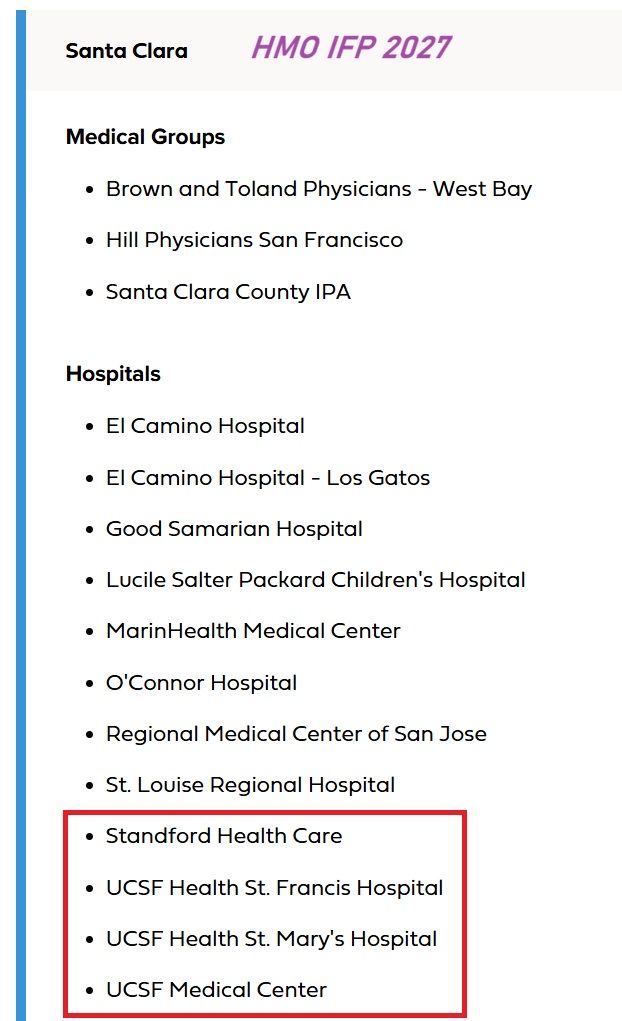
Blue Shield IFP Exclusive PPO Network by County Page
Blue Shield IFP Trio HMO Network by County Page
How to Choose
Start by deciding whether you could qualify for a Covered California subsidy. If there is any realistic chance that you may qualify, compare exchange and off-exchange options carefully before enrolling.
Next, evaluate more than the monthly premium. Compare the deductible, maximum out-of-pocket limit, office visit copayments, prescription coverage, imaging costs, emergency care, and hospital coinsurance. A lower premium can be attractive, but it may shift more of the cost to you when you need care.
Finally, verify your doctors, medical group, prescriptions, and preferred hospitals directly with Blue Shield before enrolling. Provider participation and plan details can change, and a hospital’s presence in a network does not automatically mean its affiliated physicians participate.
Bottom line: Blue Shield’s off-exchange plans may offer meaningful savings for Californians who will not receive a subsidy. The best value depends on your location, preferred providers, expected health care use, and ability to manage a higher deductible or coinsurance.
This article is an educational summary of preliminary 2027 plan information. Benefits, premiums, and provider participation should be confirmed in official Blue Shield plan documents before enrollment.
YouTube video on Blue Shield 2027 IFP