Three off-exchange PPO plans offer broader access to out-of-state care—but network rules, costs, and plan documents still matter.

Is Blue Shield of California’s full BlueCard program back for individual and family coverage? Yes, for 2027 individual and family plans the BlueCard will be included but only on three specific PPO plans: the Bronze 7250 PPO, Silver 2800 High Deductible Health Plan PPO, and Silver 1850 PPO.
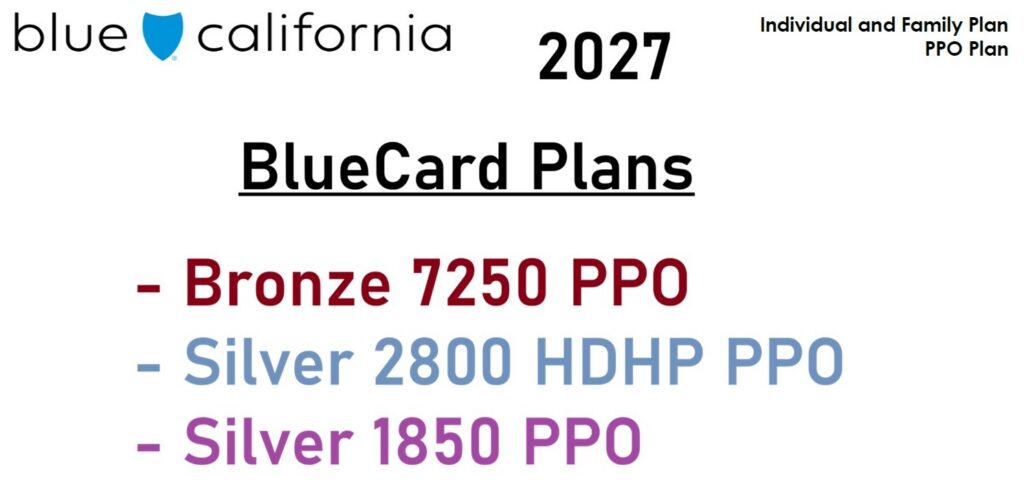
These plans are sold outside Covered California, so they do not qualify for Covered California premium subsidies. For someone who spends considerable time outside the state or needs access to an out-of-state specialist, that trade-off may be worth considering.
What does BlueCard do?
BlueCard connects participating health care providers and independent Blue Cross and Blue Shield companies through a shared network for claims processing and reimbursement. When you receive covered care outside California, the local—or host—Blue plan’s arrangements help determine how the claim is processed through Blue Shield of California.
The cost of a service can differ from what you would pay in California because negotiated rates vary by region. A participating provider is therefore important, but network participation alone does not guarantee that every service is covered.
What changed in the Evidence of Coverage?
The Evidence of Coverage, or EOC, is the detailed manual explaining how a health plan works. Basically, the EOC details what health care services will or won’t be covered and in situation. When I compared the full BlueCard program plans to the other health plans, the key distinction was in the section on care outside California.
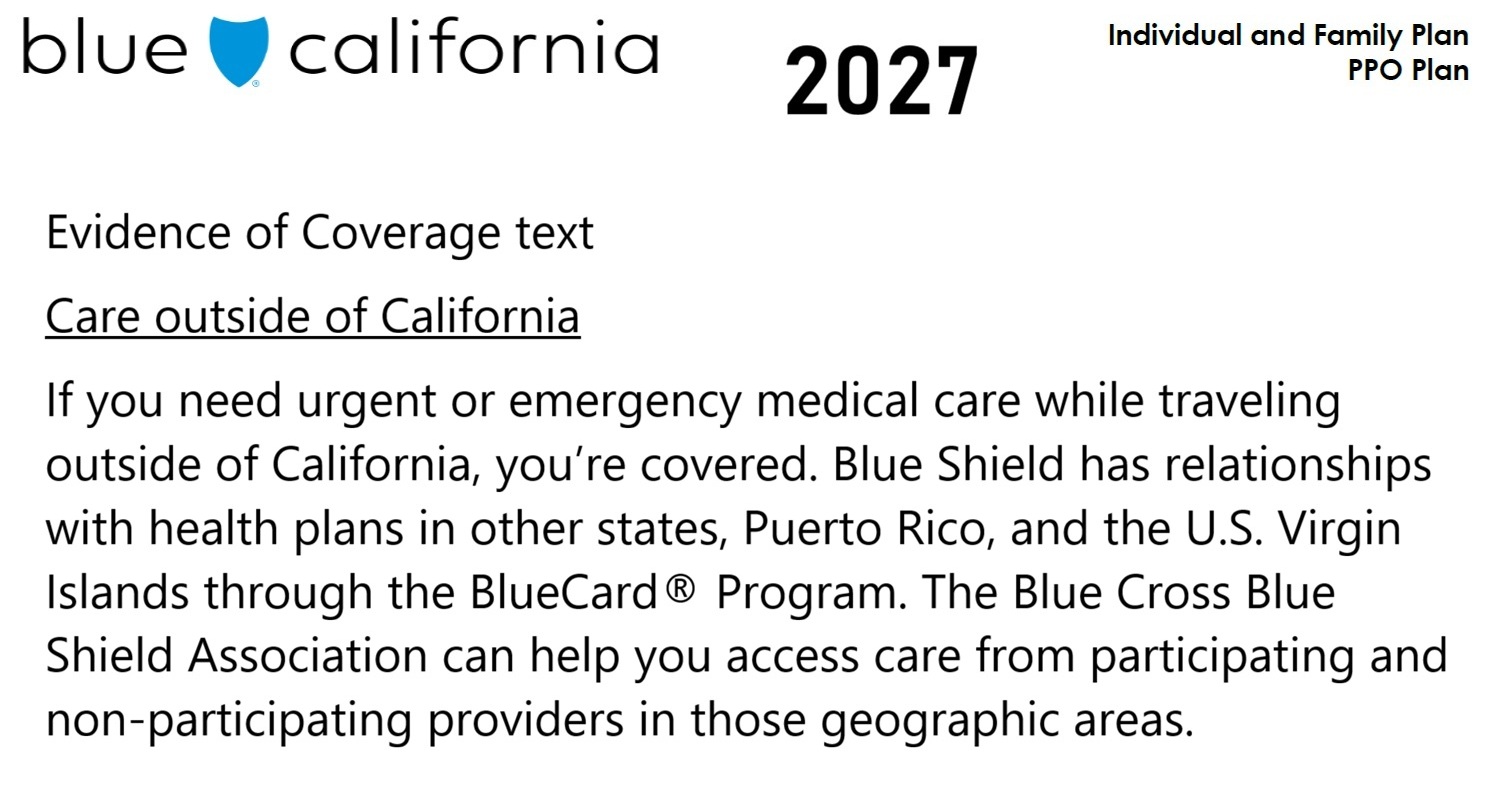
The first paragraph in all PPO health plans states –
“If you need urgent or emergency medical care while traveling outside of California, you’re covered. Blue Shield has relationships with health plans in other states, Puerto Rico, and the U.S. Virgin Islands through the BlueCard® Program. The Blue Cross Blue Shield Association can help you access care from participating and non-participating providers in those geographic areas.”
The second paragraph limits the coverage of the BlueCard –
“This Blue Shield plan provides limited coverage for health care services received outside of the Service Area. Out-of-Area Covered Health Care Services are restricted to Emergency Services, Urgent Services, and Out-of-Area Follow-up Care. Any other services will not be covered when processed through an Inter-Plan Program unless the services and out of state provider are prior authorized by Blue Shield.”
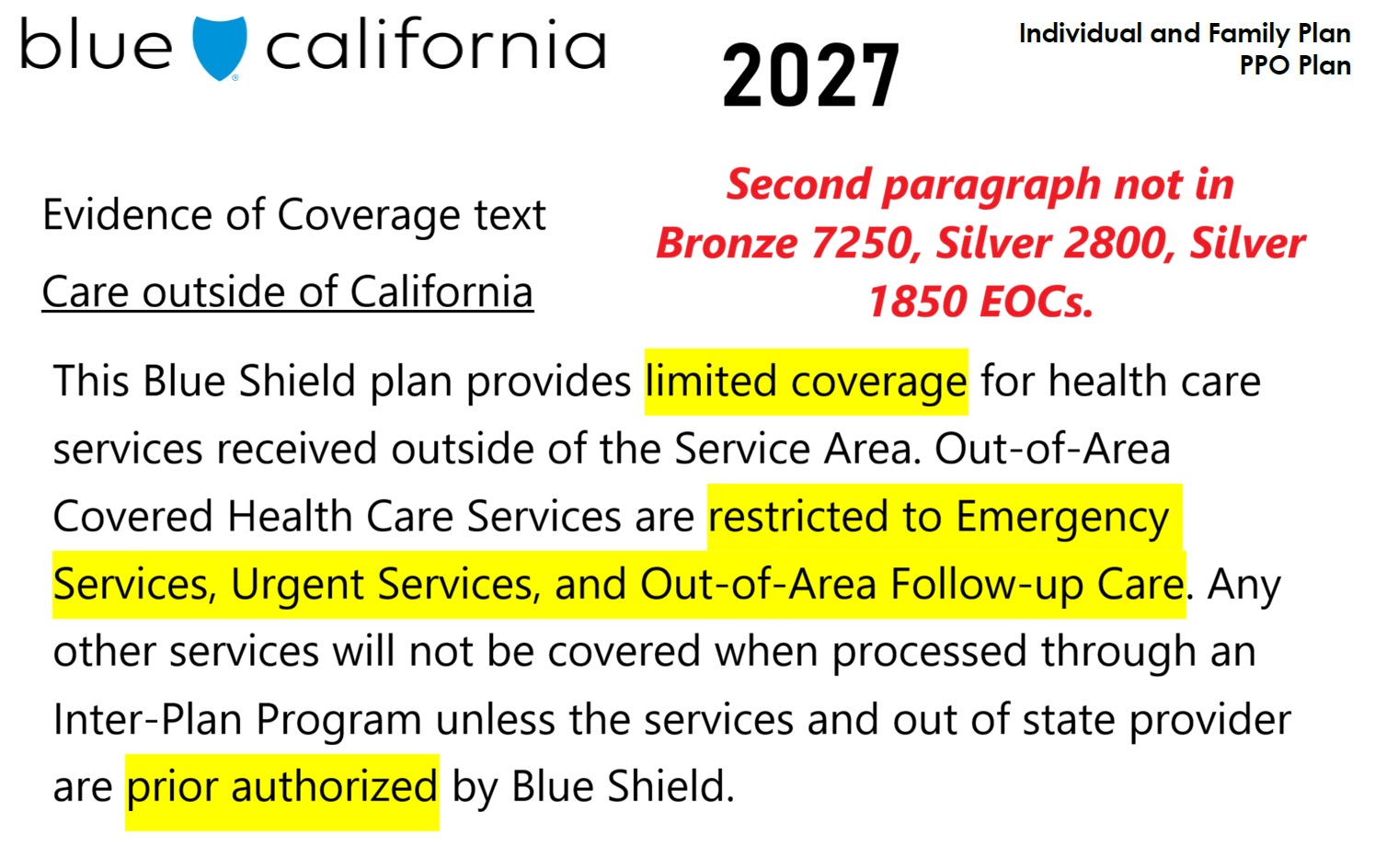
The second paragraph limiting the coverage under the BlueCard program is not present in the Bronze 7250, Silver 2800, or Silver 1850 PPO plans.
However, removing that particular restriction does not mean every treatment is automatically covered or that all prior authorization requirements disappear. Check the applicable EOC and confirm any service-specific authorization requirements with Blue Shield before scheduling care.
Comparing the three PPO plans
Bronze 7250 PPO
The Bronze 7250 has a $7,250 individual medical deductible and an $11,650 maximum out-of-pocket amount. It offers three provider visits at specified copays: $65 for primary care, $95 for a specialist, or $65 for urgent care. After those three visits are used, you are responsible for the full negotiated rate rather than those initial copays. Laboratory services are listed at $70.
This plan may appeal to someone willing to accept a higher deductible in exchange for a lower premium, while retaining access to the broader BlueCard program.
Silver 2800 High Deductible Health Plan PPO
The Silver 2800 has a $2,800 individual deductible. You are responsible for all the health and drug costs up to the deductible. After the deductible is met you go into coinsurance of ranging from 35% to 40%, depending on the service. Its stated individual maximum out-of-pocket amount is $8,700.
The lower stated out-of-pocket maximum is an important distinction from the other two plans. Review the benefit summary for services that may be exempt from the deductible.
Silver 1850 PPO
The Silver 1850 has a $1,850 individual medical deductible, but many routine services are not subject to it. For example, primary care visits have a $55 copay. The plan has $11,500 individual maximum out-of-pocket amount.
Emergency room care has a different cost structure from the flat copay approach applied in the standard Silver 70 plan. An emergency room admission with have a $300 visit charge plus 40% coinsurance. That difference deserves attention when comparing plans.
For all three options, confirm which expenses count toward the stated out-of-pocket maximum. Do not assume it caps every possible expense, including premiums or noncovered services.
Evidence of Coverage Documents
Sample premiums: coverage without a subsidy
Below are the rates for a 40 year old individual in San Francisco, Los Angeles, and San Diego for the 2027 plan year. The rates are for the Silver 1850, Silver 2800, and Bronze 7250 PPO plans. All these plans are offered off-exchange with no subsidy from Covered California.
| Plan named in the transcript | San Francisco | Los Angeles | San Diego |
| Silver 1850 PPO | $1,004 | $822 | $864 |
| Silver 2800 HDHP | $973 | $783 | $838 |
| Bronze 7250 PPO | $862 | $693 | $742 |
Rates vary by age and location. Request a quote for the person who will enroll, and compare the full premium with any subsidized Covered California alternative.
Who should consider an off-exchange BlueCard plan?
Broader out-of-state access may be especially useful in several situations:
- Extended travel or work assignments. If you spend weeks or months outside California, access to local participating providers for non-emergency care may be valuable.
- Homes in two states. People who divide their time between California and another state may want more flexibility than emergency and urgent care coverage alone provides.
- Living near the state border. A California resident in Truckee, for example, may prefer to see a BlueCard participating provider in Reno. Confirm the provider’s participation and the plan’s rules before making an appointment.
- Specialized treatment. If an out-of-state specialist offers care for a serious illness, a plan with broader BlueCard benefits may offer an alternative to having that care treated as out of network, subject to coverage and authorization requirements.
Does the whole family need the same plan?
Not necessarily. As I explain in the video, family members can have different coverage arrangements. For example, parents and one child might remain in Covered California coverage, potentially with subsidies, while another child who needs an out-of-state specialist enrolls in an off-exchange BlueCard eligible plan.
This is a scenario to evaluate, not an automatic savings strategy. Confirm enrollment eligibility, subsidy implications, and the costs of separate plans before making changes.
Before you enroll or schedule out-of-state care
- Confirm the exact plan and coverage year. Do not assume that every Blue Shield PPO includes the same BlueCard benefits.
- Read the EOC. Review care outside California, exclusions, and authorization requirements for the service you need.
- Check the provider and facility. Use Blue Shield’s provider search or contact member services to verify participation in the applicable BlueCard network.
- Ask how the service will be covered. Confirm deductible, copay, coinsurance, and any required authorization before treatment.
- Compare total costs. Consider the unsubsidized premium as well as expected medical expenses and the value of out-of-state access.
The bottom line
The return of broader BlueCard benefits on these three off-exchange PPO plans may provide a useful option for Californians who need more than emergency or urgent care while outside the state. The key question is whether that flexibility justifies paying the full premium without a Covered California subsidy.
Start with the exact plan’s EOC, verify your preferred providers, and get a personalized quote. If you have questions about how these options fit your situation, leave a comment and I will do my best to help.
YouTube video on Blue Shield BlueCard 2027.