What to know about Kaiser’s off-exchange plans and rates in California. For 2027, Kaiser Permanente will offer individual and family plans throughout most of California, concentrated in the major urban and suburban areas rather than rural ones. Here’s a look at the plans, how they differ, and what they cost.

Subsidies and Covered California
If you are eligible for a subsidy, going through Covered California is a good way to go. Kaiser will offer its standard benefit design plans there, and the subsidy can significantly reduce your premium.
In California, however, the income limit for a subsidy is fairly low. A single individual must make less than $63,840, and a couple filing jointly less than $86,560. That leaves many people outside the subsidy range altogether.
Off-Exchange, Non-Standard Benefit Design Plans
Kaiser, like some other carriers, offers non-standard benefit design plans off-exchange that are not available through Covered California. They can be less expensive and a good deal, especially if you will never qualify for a subsidy.
The “design” refers to the cost sharing between you and the plan: who pays how much first, plus deductibles, copays and maximum out-of-pocket. The healthcare services covered are the same, and pre-existing conditions are not considered. It is only about how soon the plan starts paying.
Bronze 8200 and Silver 70 High Deductible Health Plan
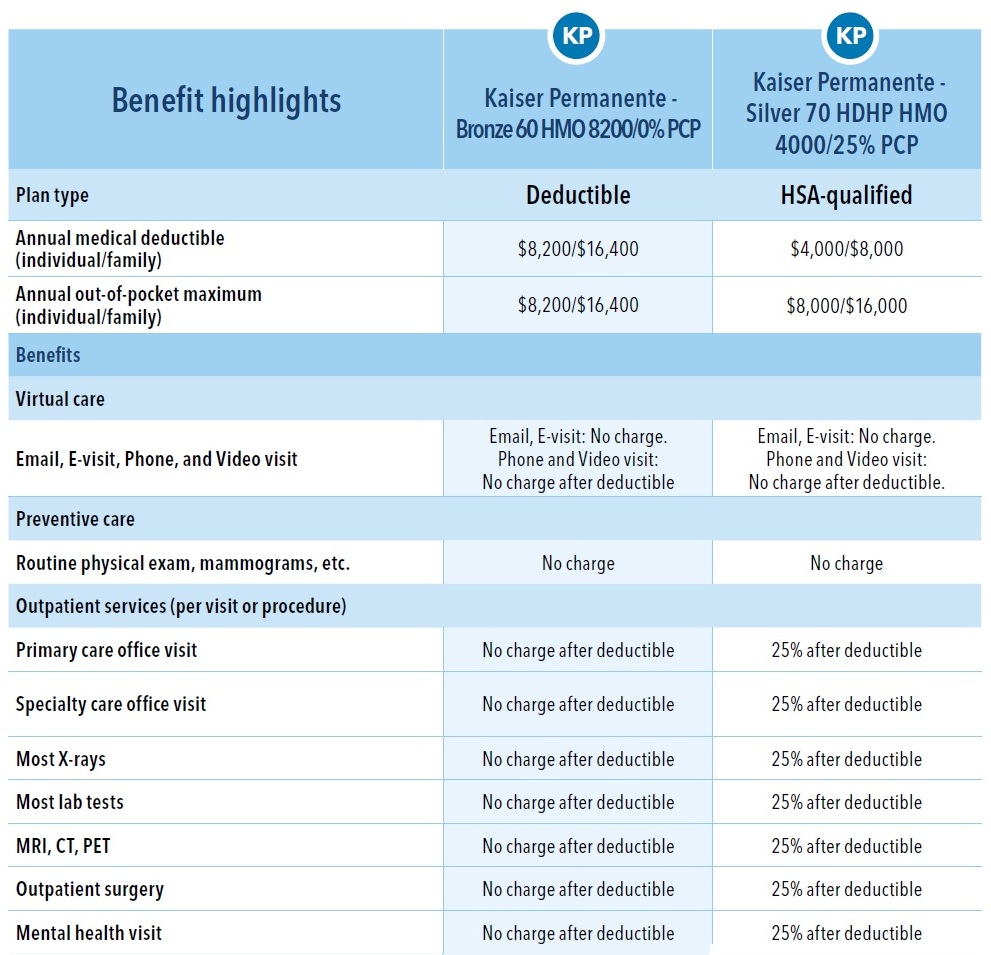
The first two plans are the Kaiser Bronze HMO 8200/0% and the Kaiser Silver 70 High Deductible Health Plan 4000/25%. The first number is the deductible; the second is the primary care visit copay or coinsurance.
- Bronze 8200: The deductible is $8,200 and so is the maximum out-of-pocket. Once you have accrued $8,200 in healthcare and prescription costs, you are done for the year. It is essentially a catastrophic plan.
- Silver 70 HDHP: The deductible is $4,000 and the maximum out-of-pocket is $8,000. After the deductible you pay 25% coinsurance until the combined total reaches $8,000. The plan is HSA-compliant, so you can contribute to a health savings account, deduct it on your federal tax return, and pay for healthcare, dental and vision from it.
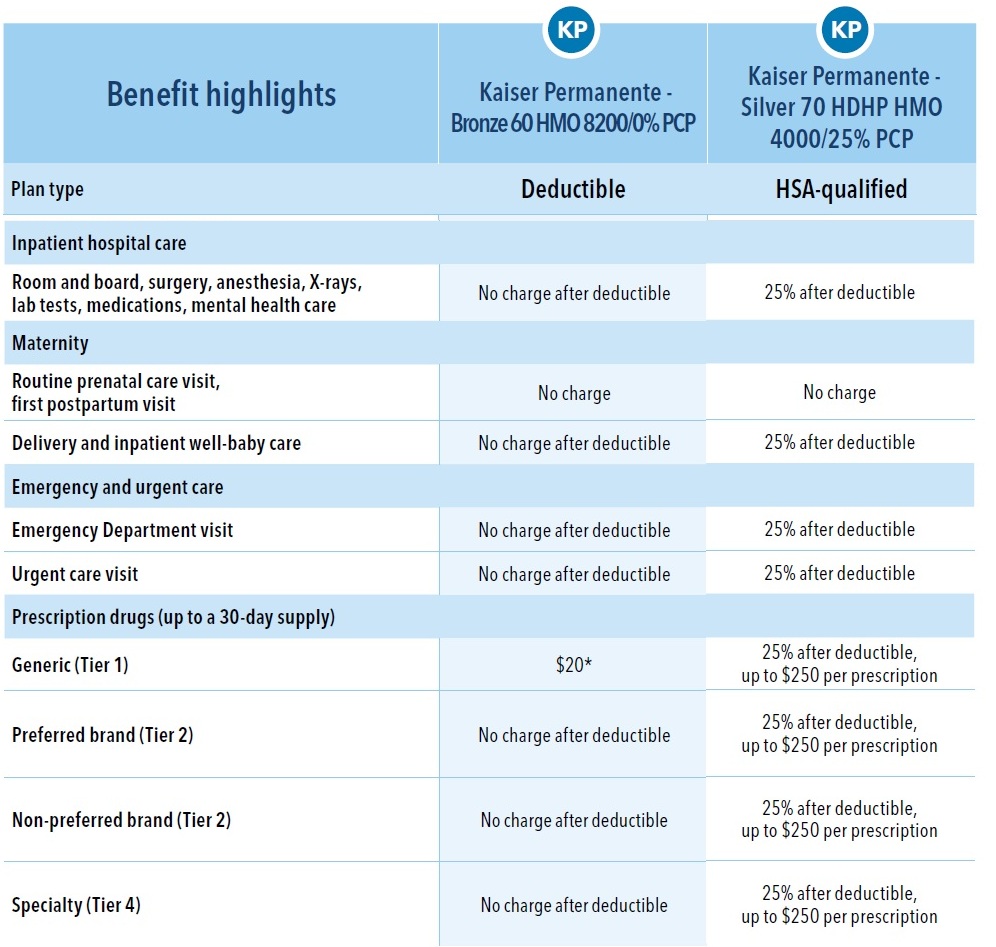
Neither plan covers phone or video visits, though email and e-visits are free. Primary care, x-rays and outpatient services are subject to the deductible on the Bronze plan; after you meet it, there is no charge. On the Silver HDHP, you pay 25% on every dollar after the first $4,000. Inpatient hospital care works the same way: no charge after $8,200 on the Bronze, 25% after $4,000 on the Silver.
On prescriptions, the Bronze plan covers Tier 1 generics at no more than $20 per month; otherwise you meet the $8,200 first. The Silver HDHP applies 25% coinsurance with a maximum of $250 per prescription.
Silver 70 2850/50
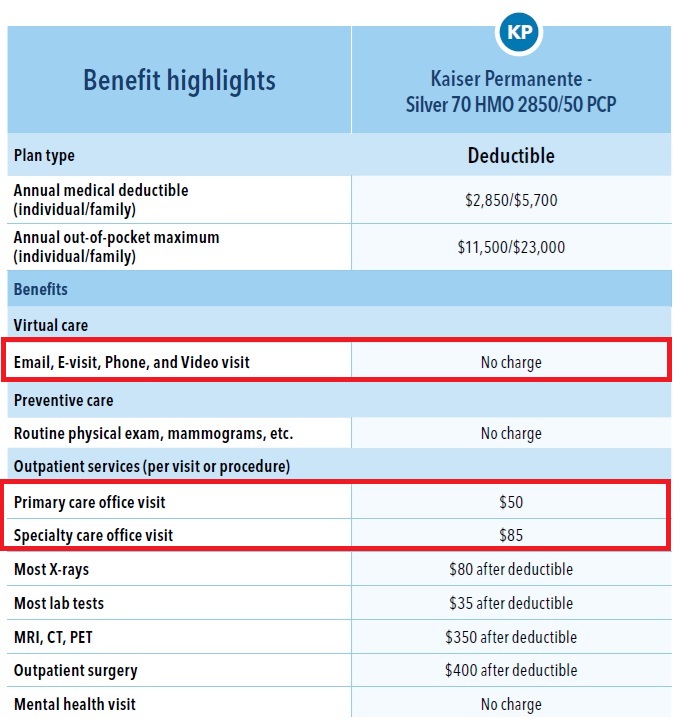
This plan has a $2,850 medical deductible for some services, a $50 copay for primary care and a maximum out-of-pocket of $11,500. Email, e-visits and video visits are free. Primary care visits are $50 and specialty visits are $85.
The key thing to watch: x-rays, labs, MRIs and outpatient surgery are subject to the $2,850 deductible before the copay applies. Routine labs can come as a shock if you haven’t met the deductible first.
After the deductible, hospital care and delivery are 35% coinsurance, and the emergency room is $350. Urgent care is a flat $50 and not subject to the deductible. Tier 1 generics are $20; brand names and higher tiers apply after a $500 pharmacy deductible, with $85 or 35% for Tier 4. It can be a good plan if you understand which services are subject to the deductible, so there are no surprises.
Gold 750 and Gold High Deductible 2500
Kaiser also offers two off-exchange gold plans: the Gold 750/35 and the Gold High Deductible 2500/15%.
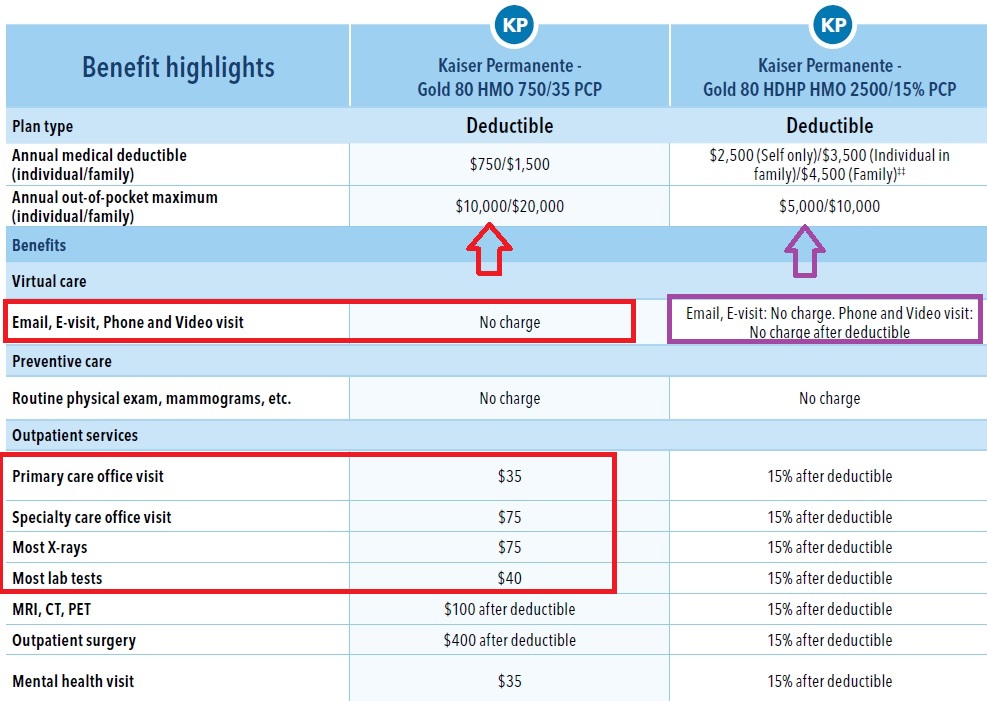
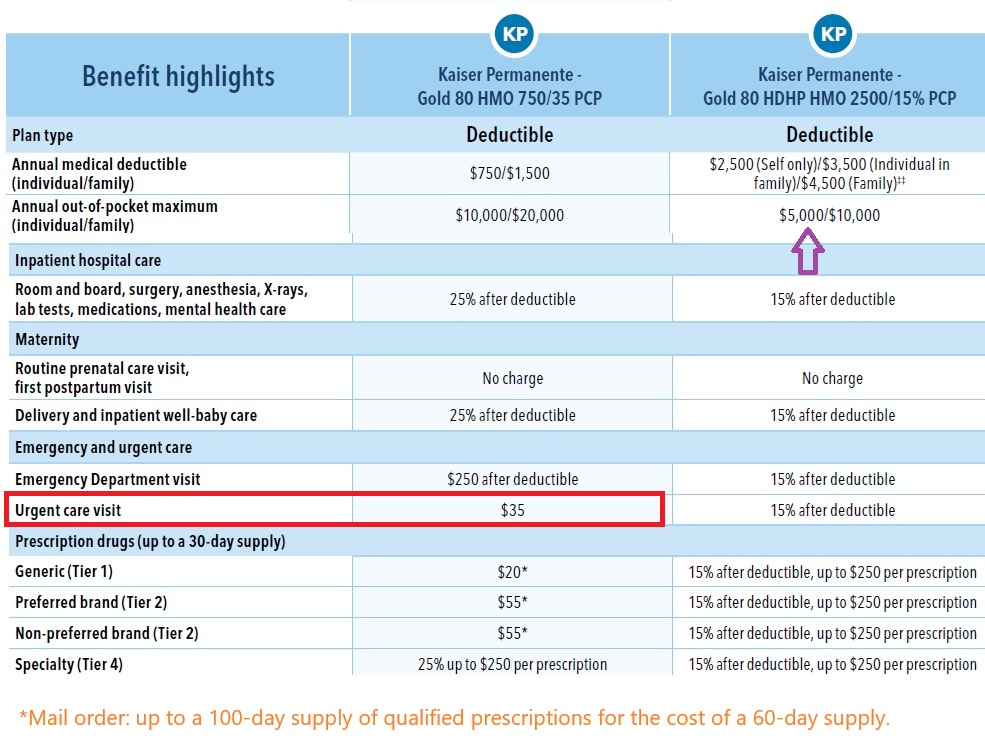
- Gold 750: A $750 medical deductible for some services and a $10,000 maximum out-of-pocket.
- Gold HDHP: A $2,500 deductible, then 15% coinsurance, with a $5,000 maximum out-of-pocket, half that of the Gold 750. It is also HSA-compliant.
This is where the Gold 750 shines. Primary care is $35, specialty visits are $75, most x-rays are $75 and labs are $40, none subject to the deductible. For MRIs and outpatient surgery you meet the $750 deductible first, then pay a copay.
Hospitalization is $750 and then 25% coinsurance up to the maximum. Emergency room is $250 after the deductible, and urgent care is a flat $35. Prescriptions run up to $20 for Tier 1, $55 for Tier 2 non-preferred brand, with mail order of up to a 100-day supply for the cost of 60 days.
With the Gold HDHP, you spend $2,500 and then pay just 15% for most services. Kaiser has a fee list for many services, and its fees are reasonable compared with other providers I have seen.
2027 Rates for a 40-Year-Old
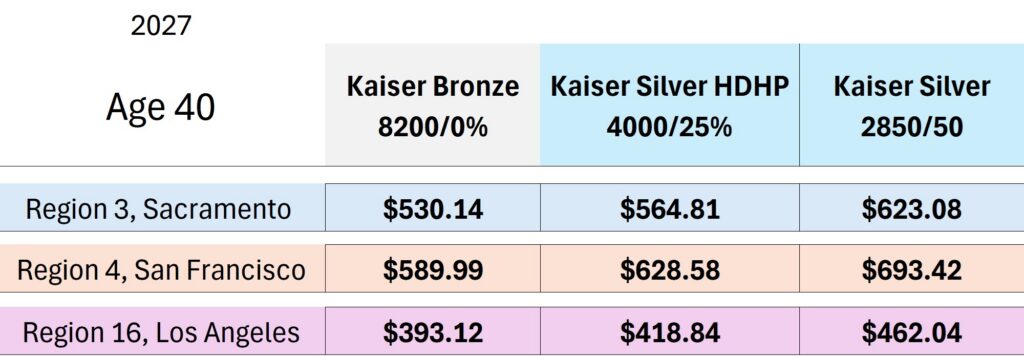
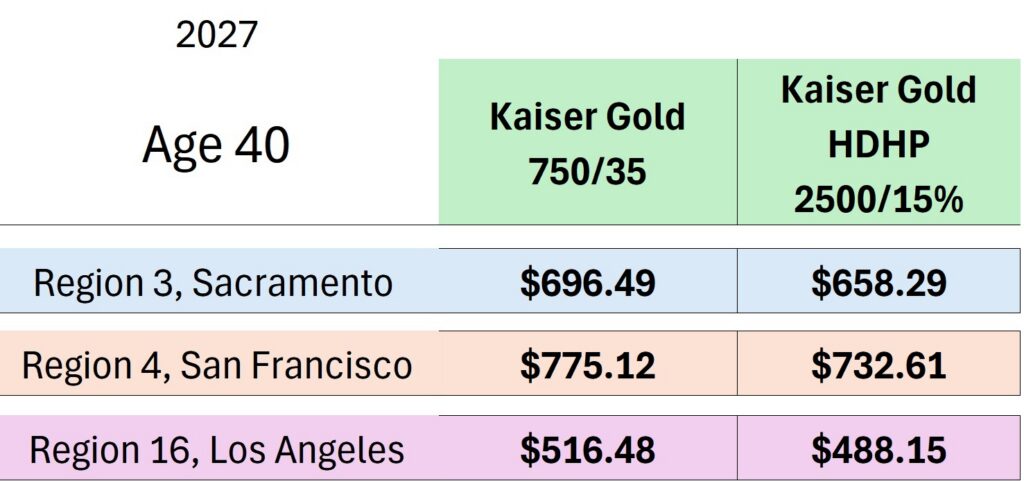
Here are monthly premiums for a 40-year-old in three regions: Region 3 (Sacramento, Placer, Yolo and parts of El Dorado County), Region 4 (San Francisco City and County) and Region 16 (West Los Angeles).
| Plan | Region 3 Sacramento | Region 4 San Francisco | Region 16 West LA |
| Bronze HMO 8200/0% | $530 | $589 | $393 |
| Silver 70 HDHP 4000/25% | $564 | $628 | $418 |
| Silver 70 2850 | $623 | $693 | $462 |
| Gold 750/35 | $696 | $775 | $516 |
| Gold HDHP 2500/15% | $658 | $732 | $488 |
Moving from bronze to silver to gold, premiums go up while cost sharing and the maximum out-of-pocket generally come down. You pay for that protection in the premium.
Two comparisons stand out. The Silver HDHP costs only about 6% more than the Bronze 8200, with a similar maximum out-of-pocket, which may be worthwhile in some situations. And the Gold HDHP has a maximum out-of-pocket of $5,000, half that of the Gold 750 ($10,000), with premiums roughly 6% lower. If you think of health insurance as asset protection, the Gold HDHP is a pretty good deal for limiting your maximum exposure through Kaiser doctors and hospitals.
Understanding Metal Tiers
You’ll see labels like Bronze 60, Silver 70, Gold 80 and Platinum 90. Those are actuarial values. On a Bronze 60 plan, the average person has 60% of their healthcare costs covered by the plan; on a Gold 80, 80%. As you move up from bronze to platinum, deductibles shrink or disappear, and copays and coinsurance get smaller.
Building the Right Plan for Your Family
It can all be confusing. Family members might be in different plans, such as a bronze for one and a gold for another, or even with different carriers. When you are not receiving a subsidy, every dollar counts, and sometimes we have to look around to build a family plan that minimizes premiums while still providing the coverage and care each person needs.
YouTube video on Kaiser off-exchange plans for 2027.