The Centers for Medicare and Medicaid Services (CMS) has now released the 2027 figures. Here is what is changing. Part A and Part B costs are inching up, but the income-related surcharges are where people get surprised
Part B: Premium and Deductible
The base Part B premium rises from $202.90 in 2026 to $209.40 in 2027. If you collect Social Security retirement benefits, this amount is deducted from your deposit. Otherwise, you pay it quarterly. It is a modest increase, and the Social Security Cost of Living Allowance should be larger than that, so most people won’t see much impact on their deposits.
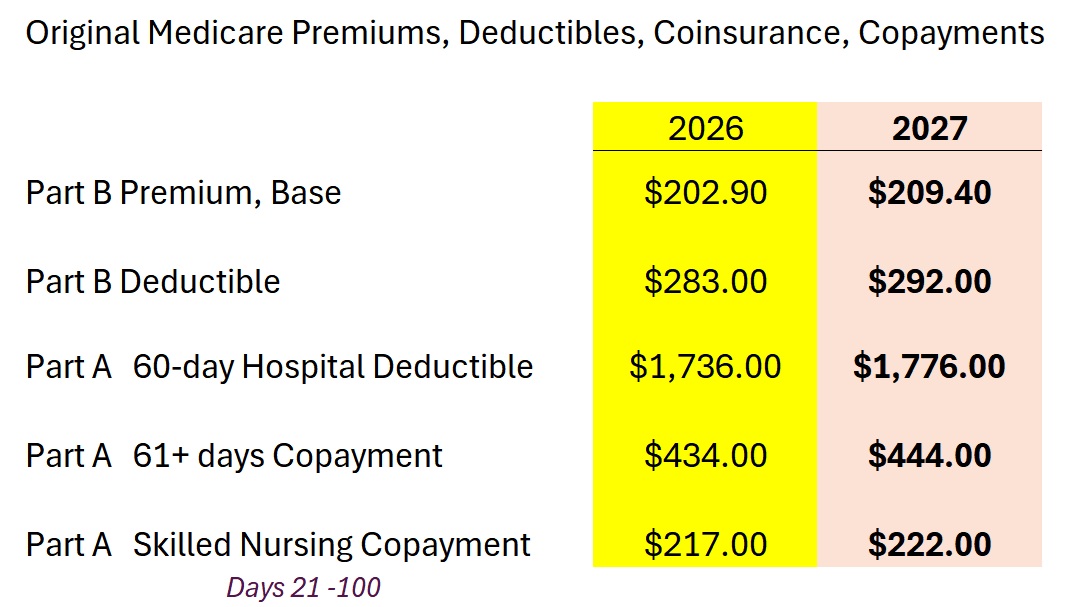
The Part B deductible increases from $283 to $292. Part B covers outpatient services: office visits, labs, tests, X-rays, and durable medical equipment. With Original Medicare, once you have incurred $292 in covered services, you move into 20% coinsurance. If you have a Medigap Plan G, you pay the $292 and Plan G covers the remainder of that 20% for the rest of the year. Not too bad an increase.
If you are enrolled in a Medicare Advantage HMO plan, there is generally no deductible for health care services. The Medicare Advantage plans have set copays for routine health care services. However, your drug coverage within the Medicare Advantage plan may have pharmacy deductible.
Part A: Hospital and Skilled Nursing Costs
Part A covers hospitalization. The Part A deductible rises from $1,736 in 2026 to $1,776 in 2027 for a 60-day stay in a hospital. Many Medicare Supplement plans cover this deductible if you are hospitalized. It doesn’t come into play much with a Medicare Advantage plan, since many of those plans charge a set copayment per day for the first five or six days.
| Part A Cost | 2026 | 2027 |
| Hospital deductible (per benefit period) | $1,736 | $1,776 |
| Hospital copayment, days 61+ (per day) | $434 | $440 |
| Skilled nursing facility copayment, days 21–100 (per day) | $217 | $222 |
Costs like these are what break the bank for people without a Medicare Supplement or Medicare Advantage plan, because Original Medicare has no cap on out-of-pocket costs. The 20% Part B coinsurance on high-cost services and extra hospital days adds up quickly.
Skilled nursing is a good example. Original Medicare allows up to 100 days in a skilled nursing facility. The first 20 days are $0 cost; days 21 through 100 carry a daily copayment, rising from $217 to $222 in 2027. Advantage plans have their own cost sharing for skilled nursing, usually lower than Original Medicare.
IRMAA: The Surcharge That Shocks People
Another area that surprises many of my clients is the Income Related Monthly Adjustment Amount (IRMAA). Part B and Part D are subsidized by the federal government to lower your monthly premium. Part A is generally premium-free if you worked 10 years (40 quarters). For Part B, the more you earn, the less you are subsidized, so you pay a larger share of the actual cost of the health insurance coverage.
For 2027, the Social Security Administration looks at your 2025 tax return. Here is how it works for a single filer:
| 2025 Income (Single Filer) | Total Part B Premium | Part B Add-On | Part D Add-On |
| Up to $112,000 | $209.40 | None | None |
| $112,000 – $141,000 | $293.10 | $83.70 | $15.40 |
| $141,000 – $177,000 | $418.80 | $209.40 | $39.70 |
| Over $500,000 | $711.80 | $502.40 | $96.40 |
If you aren’t taking Social Security and receive a quarterly bill from Medicare, this is where the reaction is “whoa.” It piles up quickly. The Part D add-on applies if you are in a Part D drug plan, including the drug coverage built into a Medicare Advantage plan. Tiers between those shown above step up in the same graduated way.
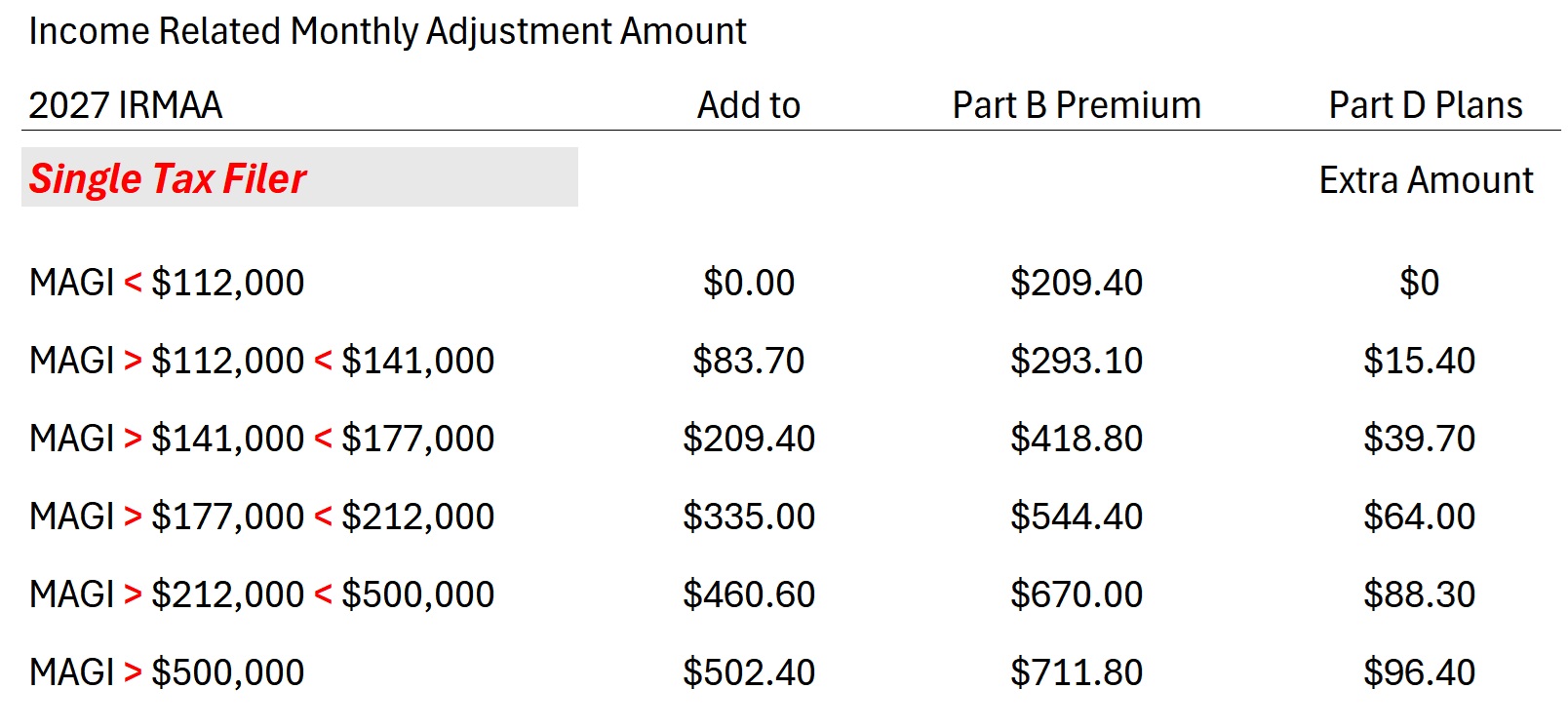
Medicare does not supply a set premium amount for the Part D IRMAA because all of the Part D drug plans have different premiums amounts. Consequently, in addition to your stand alone Part D drug plan, you will be invoice the IRMAA on the Medicare invoice or deducted from your Social Security deposit.
Joint Filers
The numbers are very similar for joint filers. Original Medicare is individual coverage, with no family plan, but if you are married and file jointly you can earn more before IRMAA applies. Your spouse may not be on Medicare yet, or may still be working, which makes higher household incomes common.
| 2025 Income (Joint Filers) | Total Part B Premium (each person) | Part D Add-On (each person) |
| Up to $224,000 | $209.40 | None |
| $224,000 – $282,000 | $293.10 | $15.40 |
| Over $750,000 | $711.80 | $96.40 |
If both spouses are on Medicare, each is billed the add-on. The intermediate tiers mirror the single-filer increases.
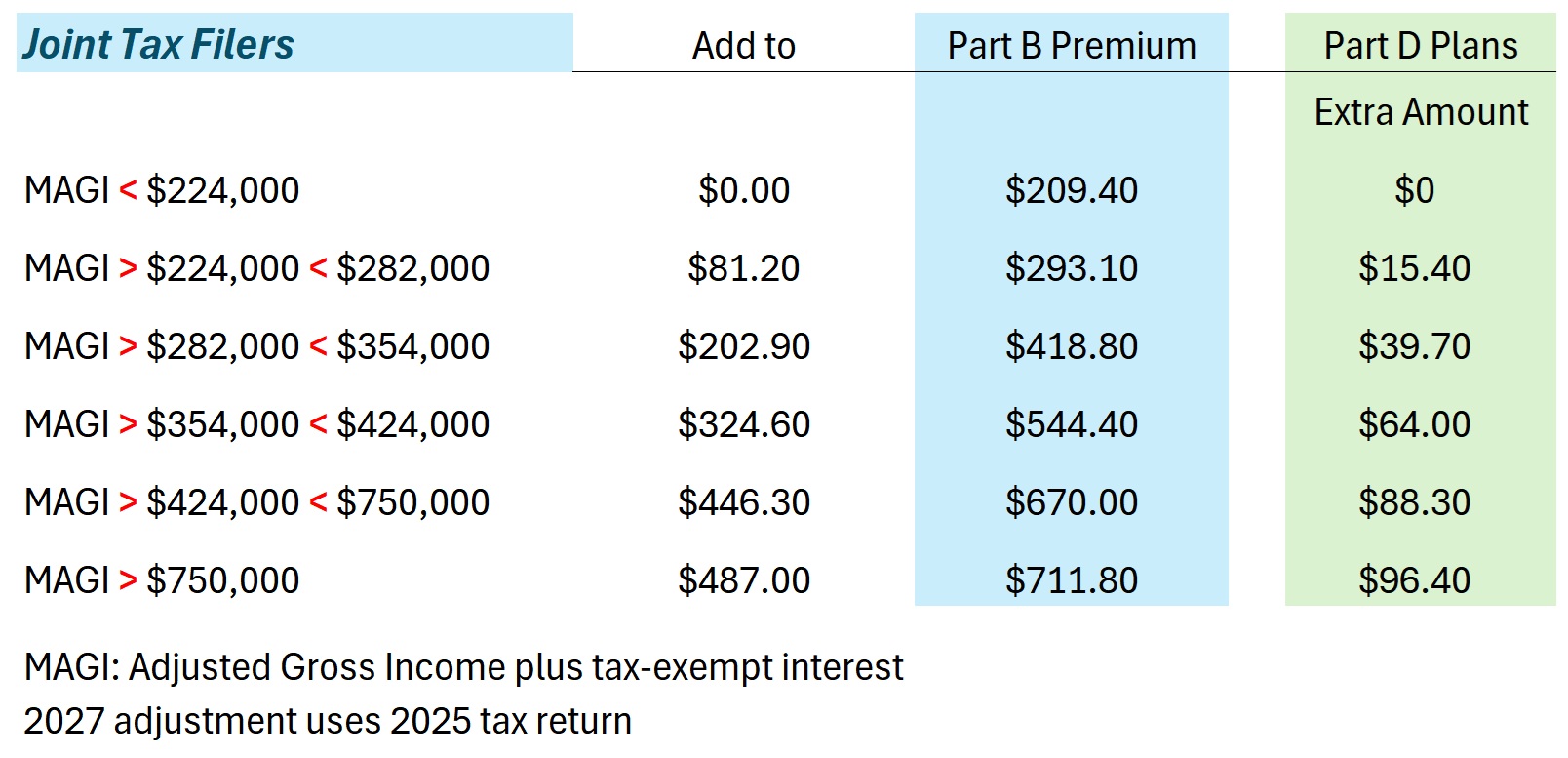
Keep in mind that the measure is modified adjusted gross income (MAGI): your adjusted gross income plus tax-exempt interest, such as interest from municipal bonds. Income you normally don’t pay taxes on can still push you over a threshold. Also, the government usually looks back two years, so 2025 income determines your 2027 surcharge.
Late Enrollment Penalties
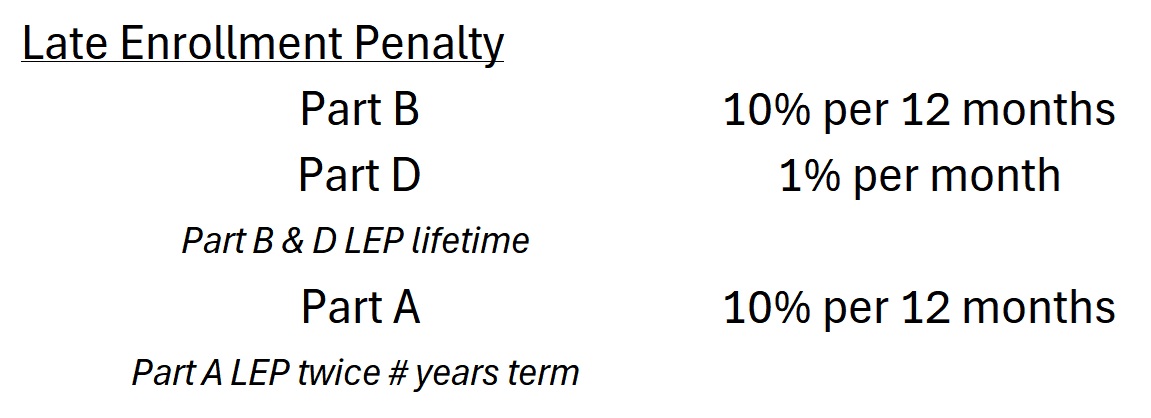
There are no real changes to the late enrollment penalties. If you don’t have creditable health coverage when you become eligible for Part B and choose not to enroll, you pay an additional 10% for every 12 months you were eligible but not enrolled.
I have seen this with people who worked in the U.S., kept a home in the Philippines, and spent a couple of years there without enrolling in Original Medicare because they weren’t living in the country. When they return, re-establish residency, and apply, they are hit with the Part B late penalty and potentially a Part D penalty.
The Part D penalty is 1% of the national base premium for every month you went without drug coverage. With the national average running around $40 to $45 per month, that is roughly 40 cents for each month without Part D. These penalties can add up, but it is IRMAA that really shocks people.
The Bottom Line
Overall, the base Part B premium, deductibles, and hospital copayments are fairly stable and haven’t gone up much. If you have questions or comments, leave them below and I will do my best to answer.
YouTube video on Medicare premiums and deductibles.